In this two-day, hands-on workshop, participants investigate realistic ransomware and APT intrusion scenarios using forensic datasets and industry-standard tools, including SIEMs and forensic utilities.
Next scheduled date:WWHF Mile High 2027 - Link at bottom.
Description
Modern enterprise intrusions involve sophisticated attacker techniques spanning endpoints, networks, identities, and security infrastructure. Investigating these threats requires analysts to understand attacker behavior, correlate evidence across multiple sources, and reconstruct complex attack sequences.
In this two-day, hands-on workshop, participants investigate realistic ransomware and APT intrusion scenarios using forensic datasets and industry-standard tools, including SIEMs and forensic utilities.
Through practical exercises, students learn to investigate commonly observed attacker techniques, including SSH reverse tunneling, RDP-based lateral movement, in-memory execution, Kerberoasting, credential abuse, and defense evasion using vulnerable drivers (BYOVD).
Throughout the workshop, we also explore how AI can augment traditional DFIR workflows. Participants apply modern investigation methodologies, progressing from hands-on forensic analysis to AI-assisted artifact interpretation, evidence correlation, investigative decision-making, and automated triage.
Using practical examples, reusable code snippets, and lightweight investigation harnesses, students learn how to integrate LLMs into selected DFIR workflows, evaluate AI-generated findings, and apply best practices for evidence-driven analysis.
The focus is on developing practical investigation skills while learning how AI can help analysts work more efficiently—not on building AI applications from scratch.
Who Should Take This Course
SOC analysts, incident responders, threat hunters, DFIR practitioners, and security engineers looking to strengthen their practical enterprise investigation skills and explore how AI can augment their existing workflows.
Participants will gain hands-on experience investigating real-world attacker techniques while exploring how AI-assisted analysis and automation can improve investigative efficiency, detection engineering, and incident response workflows.
Participants should have a basic understanding of Windows systems, networking, and security fundamentals. No prior AI development experience is required.
What You’ll Learn
Enterprise DFIR fundamentals: Apply structured investigation methodologies across endpoint, network, and authentication evidence.
Ransomware and APT investigations: Investigate SSH tunneling, lateral movement, in-memory execution, Kerberoasting, credential abuse, and BYOVD techniques.
Forensic analysis and correlation: Analyze Windows artifacts, event logs, memory evidence, and network telemetry to reconstruct attacker activity.
AI-assisted investigation and detection engineering: Use LLMs to interpret evidence, develop investigative queries and detection logic, correlate events, and identify suspicious behavior.
Practical AI automation: Explore reusable code snippets and lightweight investigation harnesses for triage, classification, and evidence analysis.
Key Takeaways
Investigate realistic ransomware and APT-style incidents using modern DFIR techniques.
Analyze host, network, and log evidence to reconstruct attacker activity.
Investigate common TTPs, including credential abuse, lateral movement, in-memory execution, and defense evasion.
Apply AI-assisted workflows to accelerate forensic triage, evidence correlation, and detection engineering.
Explore practical AI automation using reusable code snippets and lightweight investigation harnesses.
System / VM / Lab Requirements
A computer with a reliable internet connection
An RDP client to access the provided cloud-based lab environment
An OpenAI API key with available API credits for AI-assisted exercises
Each student will receive a dedicated, cloud-hosted lab VM with the required forensic tools and datasets preconfigured. No additional software downloads or local lab setup are required beyond an RDP client.
Syllabus
Day 1 — Enterprise DFIR Fundamentals & AI-Assisted Investigations
Modern Threat Landscape
Ransomware and APT actors, tactics, techniques, and procedures (TTPs)
Enterprise attack patterns and investigation challenges
Enterprise DFIR Methodologies
Incident response processes and investigative workflows
Evidence collection, forensic analysis, and correlation
AI-Assisted DFIR Fundamentals & Workflows
LLM fundamentals and applications in incident investigations
AI investigation assistants and lightweight harnesses
Developing AI-assisted workflows for forensic analysis and triage
Ransomware Investigation Scenario
Endpoint and network forensic analysis
Log analysis and event correlation
Disk and memory forensics
Timeline reconstruction and attack scoping
AI-assisted analysis and investigation workflows
Investigation findings and case review
Day 2 — Advanced Intrusion Investigations & AI-Assisted Detection
Advanced Attacker Techniques
APT intrusion patterns and investigation approaches
Investigating multi-stage attacks across enterprise environments
APT Investigations & AI-Assisted Analysis
Investigating advanced attacker techniques:
SSH reverse tunneling and RDP-based lateral movement
In-memory execution and .NET-based threats
Kerberoasting, credential abuse, and lateral movement
Defense evasion and vulnerable driver exploitation (BYOVD)
Forensic analysis, evidence correlation, and attack reconstruction
Leveraging AI assistants for investigative analysis, triage, and detection engineering
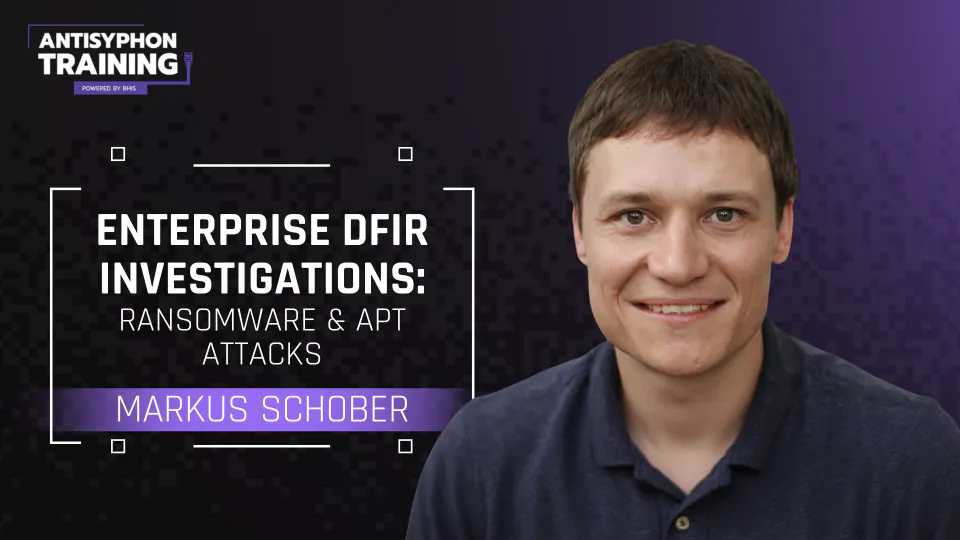
Markus Schober is the founder of a blue team training and consulting company named Blue Cape Security. Prior to that, he served as a manger and Principal Security Consultant at IBM X-Force Incident Response. Over the past decade he has led numerous cyber security breach investigations for major organizations, where he specialized in Incident Response, Digital Forensics and Crisis Management.
This class is being taught at Wild West Hackin’ Fest – Mile High 2027.