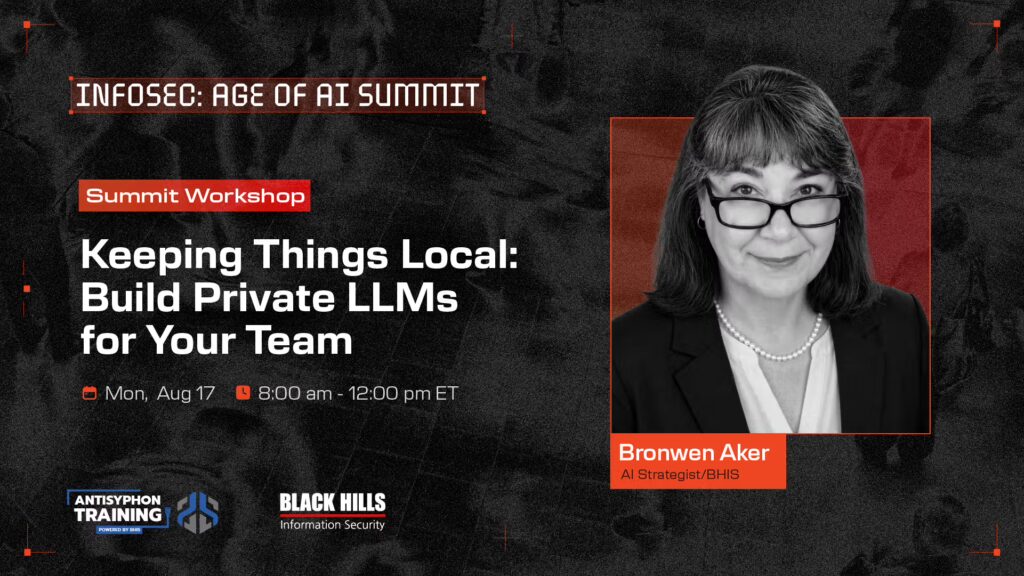
This four-hour workshop takes security practitioners past simply installing Ollama and into building something bigger: a locally hosted model your whole team can reach.
Next scheduled date:August 17th, 2026 @ 8:00 AM ET
Description
What good is a private AI if you can only use it from the system it runs on?
This four-hour workshop takes security practitioners past simply installing Ollama and into building something bigger: a locally hosted model your whole team can reach.
You’ll customize models for your own workflows, connect systems over an encrypted mesh network, and put an authentication layer in front of everything. Because it all runs on hardware you control, sensitive data never leaves your environment while access expands beyond a single desk.
Show up with a system that can run two virtual machines, and walk out with a working private service you built yourself.
Once you’ve built a local LLM, learn to prompt it for reliable, consistent results in the follow-up workshop Prompt Engineering with Local LLMs.
Who Should Take This Workshop
Security practitioners, sysadmins, and technical folks who want AI capability without shipping sensitive data to a third party. If you handle client data, work under confidentiality constraints, or just want to know exactly where your prompts go, this workshop is for you. It is a strong fit for:
Red teamers and penetration testers, who get a private AI that won’t leak client data during an engagement plus mesh networking they can use on assessments
Consultants and MSSP staff who handle multiple clients’ sensitive data under contract
Anyone working in a regulated industry (healthcare, legal, finance, government) where data sovereignty is a compliance requirement, not a preference
What You’ll Learn
By the end of the workshop, you will be able to:
Install and configure Ollama on Linux and manage local models from the command line
Configure Ollama to listen on the network so other systems can use it
Customize model behavior with Modelfiles to build purpose specific assistants for your workflows
Build an encrypted mesh network with Tailscale and connect multiple machines to it
Put an nginx reverse proxy with basic authentication in front of Ollama to control who can reach it
Explain the data sovereignty case for local AI and the attack surface you take on when you expose an LLM service
System Requirements
VMware and the lab VMs are provided. Students need a laptop that can run two virtual machines at the same time:
16 GB RAM minimum (24 GB or more recommended)
60 GB free disk space
CPU with virtualization support enabled in BIOS/UEFI
Reliable internet connection (required for model downloads and Tailscale)
VM/Lab/Student Requirements
VMware and two Linux-based lab VMs will be provided for download before class, along with import instructions and credentials. Download and import everything ahead of time; model files are large and take time to download and extract. All labs are hands on and build on each other, ending with a working, authenticated, network accessible private AI service. Setting up a free Tailscale account is part of the lab, so no advance signup is needed.
Working familiarity with frontier LLMs (ChatGPT, Claude, Gemini, or similar) and basic AI/LLM concepts. You should know what a prompt is, what a model is, and what a system prompt does
Comfort with the Linux command line (editing files, installing packages, basic troubleshooting)
Comfort running privileged commands (sudo) to install packages and edit system config
Basic web/HTTP literacy (the idea of clients, servers, ports, and requests)
Basic familiarity with virtual machines (importing and running a VM in VMware)
Helpful but not required: familiarity with networking concepts (IP addresses, ports, proxies)
No prior experience with Ollama, Tailscale, or nginx is needed; every tool is introduced from scratch
Helpful but not required: familiarity with networking concepts (IP addresses, ports, proxies)
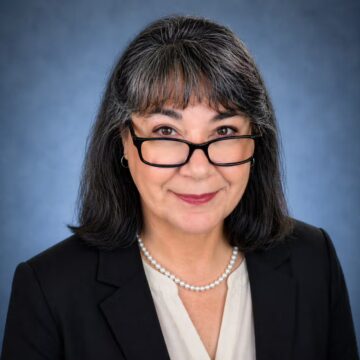
Bronwen Aker is a cybersecurity professional, data scientist, and veteran technical educator with more than forty years of public speaking experience. She began her career as a full-stack web developer before moving into penetration testing and other aspects of cybersecurity, earning both a bachelor’s and a master’s degree in cybersecurity, along with industry certifications including GSEC, GCIH, and GCFE. Bronwen’s work bridges defensive security, applied data science, and the rapidly evolving landscape of artificial intelligence, where she focuses on making AI both reliable and safe.
Register for Upcoming
Keeping Things Local: Build Private LLMs for Your Team
Live Training
Certificate of completion
6 months class recording access via Discord
For tuition assistance with this course please send an email to: [email protected]