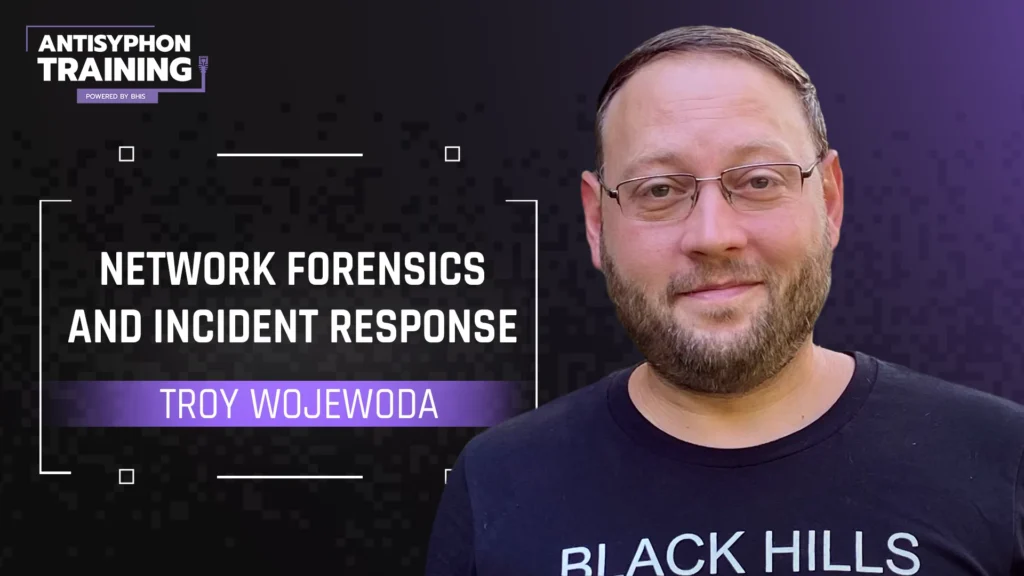
This course covers incident handling fundamentals, attacker methodologies, network protocol abuse detection, hands-on network packet analysis, Zeek scripting, flow data analysis, and real-world attack scenarios.
On-Demand $575.00
Course Length: 16 Hours
Includes a Certificate of Completion
WWHF Mile High 2026 - Link at bottom.
Description
This course covers incident handling fundamentals, attacker methodologies, network protocol abuse detection, hands-on network packet analysis, Zeek scripting, flow data analysis, and real-world attack scenarios.
Incident responders are continually faced with the challenge of collecting and analyzing relevant event data—network communications is no exception. This course uses an assortment of network data acquisition tools and techniques with a focus on open-source, vendor-neutral solutions. Students who take this course will learn how to perform network traffic and protocol analysis that ultimately supports cybersecurity incident response efforts.
From reconnaissance to data exfiltration, network traffic scales to provide a bird’s-eye view of attacker activity. Leveraging the vantage point of key network traffic chokepoints, this course explores nearly every phase of an attacker’s methodology. Students will learn network traffic analysis concepts and work through hands-on lab exercises that reinforce the course material using real-world attack scenarios.
-
System Requirements
- Option 1: Using the MetaCTF instance of the course’s VM (recommended if a local VM use is not possible and/or preferred).
- A web browser and solid internet connection.
- MetaCTF account (registration is free)
- Option 2: Download and use of local VM
- VMWare Workstation/Player 16.x or 17.x (Windows/Linux) OR VMWare Fusion/Player 12.x or 13.x (Mac OS).
- A computer with a minimum of 8GB RAM, 100GB of free disk space
- System must be able to run an Ubuntu 22.04 LTS 64-bit VM with the following minimum specs: 4GB RAM, 60GB disk space, 2 virtual processors
Syllabus
Syllabus
-
Module 1: Incident Response Fundamentals (Lecture)
-
Incident Response Metrics
-
Time Synchronization and Timelining
-
Artifact Collection
-
Events, Events of Interest, Incidents
-
Prioritization of Events to Investigate
-
Severity of Incidents
-
Applications of Forensics Analysis
-
IR Models and Associated Response Steps
-
Cyber Kill Chain Mapping in IR Investigations
-
IR Preparation and Readiness
-
Technical Control Gap Analysis
-
-
Module 2: Network Architecture & TCP/IP Fundamentals (Lecture)
-
Network Architecture Review
-
Tactical and Strategic Network Security Monitor (NSM) Placement
-
TCP/IP and OSI Models
-
IP Header
-
TCP Header
-
UDP Header
-
OS and Application Profiling
-
-
Lab 0: Introduction and Tutorial of Course Virtual Machine (Lab)
-
Students will be introduced to the Network DFIR Workstation VM and included tools.
-
-
Module 3: Network Analysis Tools & Techniques (Lecture)
-
tcpdump capture options
-
tcpdump filters
-
Wireshark
-
Tshark
-
Decrypting & Analysis of TLS Traffic with Polar Proxy
-
PCAP vs. PCAPNG Formats
-
Introduction to command tools
-
-
Lab 1: Filters – Tcpdump, Wireshark, TShark (Lab)
-
Students will gain familiarity with applying various packet filters options using tcpdump, Wireshark, and Tshark.
-
-
Module 4: Network Protocol Analysis (Lecture)
-
Network Protocols: Common uses, applications, and features
-
DNS
-
FTP
-
HTTP
-
NTP
-
RDP
-
SMTP
-
SNMP
-
SSH
-
TLS
-
-
DNS over TCP
-
Direct DNS Resolution
-
Recursive DNS Resolution
-
DNS Request Types
-
HTTP Protocol History
-
HTTP Headers
-
HTTP Client Requests and Methods
-
HTTP Response Codes
-
TLS Fingerprinting (Active/Passive)
-
ICMP Payload Analysis
-
-
Module 5: File Carving (Lecture)
-
Wireshark Export Objects
-
File Extraction using Zeek
-
Manual File Extraction
-
-
Lab 2: Carving Files out of PCAPs (Lab)
-
Students will learn how to extract files from pcap files, using various techniques.
-
-
Module 6: Attacker Tactics & Techniques (Lecture)
-
MITRE ATT&CK Tactic/Techniques
-
Strategic Web Compromises (Watering Holes)
-
Dead Drop Resolvers
-
HTTP Redirects
-
Domain Doppelganger Registration/Use
-
Base64 Encoding/Obfuscation
-
Custom Base64 Encoding/Obfuscation
-
Reverse Order Byte Delivery
-
Carrier Files
-
XOR Encryption/Obfuscation
-
Null & Key Escaping XOR Operations
-
Rolling XOR
-
Network Protocol Abuse – Real Life Examples
-
-
Lab 3: I XOR you, I XOR you NOT (Lab)
-
Students will get hands on experience with detecting and recovering encoded/encrypted data.
-
-
Lab 4: Proxy or No Proxy (Lab)
-
Students will learn how to differentiate between non-transparent proxy traffic and transparent (or no proxy) traffic. We will also get a glimpse into decrypted HTTP2 traffic.
-
-
Module 7: Zeek Intrusion Detection System (Lecture)
-
Zeek Frameworks
-
Zeek Log Analysis
-
Zeek Tips & Tricks
-
Parsing Zeek Logs
-
-
Lab 5: Parsing Zeek Logs (Lab)
-
Students will use the Zeek open-source network traffic analyzer to analyze captured network traffic explore the Zeek framework.
-
-
Module 8: Zeek Customization
-
Zeek Package Manager
-
Zeek Scripting
-
Custom Zeek Scripting for Log Enrichment
-
Custom Zeek Scripting for IR and Forensics Artifact Extractions
-
-
Lab 6: Zeek Package Manager (Lab)
-
Students will gain experience installing the ja3 zeek package using zeek’s package manager.
-
-
Lab 7: Case Matters (Lab)
-
Students will learn how to write a custom Zeek script that adds an additional column of data to zeek’s dns.log.
-
-
Lab 8: Going Postal (Lab)
-
Students will write and implement a custom Zeek script that extracts various objects [dynamically] from SMTP traffic found in a network packet capture file.
-
-
Module 9: Netflow/IPFix (Lecture)
-
Netflow Framework and Components
-
Generating flows with YAF (Yet Another Flowmeter)
-
Yaf Output Analysis
-
-
Lab 9: Flows/IPFix (Lab)
-
Students will analyze network flow traffic with the objective of detecting data exfiltration activity.
-
-
Module 10: Zeek Telemetry from Endpoints (Lecture)
-
Zeek visibility using M365 Defender Portal
-
Zeek visibility using Microsoft’s Graph API
-
-
Lab 10: Capstone Lab (Lab)
-
Utilizing only network traffic, students will apply the course’s learning objectives in a culminating exercise focused on analyzing an attack scenario and ultimately uncovering the attacker’s: intial access, tool use, command and control, and data exfiltration.
-
FAQ
• Incident Responders
• SOC Analysts
• Digital Forensic Investigators
• Network Threat Hunters
• Information Technology/Security enthusiasts wanting to expand their knowledge on network traffic analysis
-
Beginning to intermediate. Please see prerequisites for more information.
-
Students should be comfortable operating from the command-line in Debian-based Linux distributions such as Ubuntu
-
Students should be comfortable opening network packet capture files with tools like Tcpdump, Wireshark/Tshark
-
Students should be comfortable installing and running virtual machines on their computer
-
Although programming experience is not a requirement, students should be comfortable editing and running scripts such as Bash and Python
A laptop (see “System Requirements” for details)
-
Students will learn fundamental concepts of incident handling and response
-
Students will gain insight into attacker methodologies and learn various techniques to uncover adversarial activity
-
Students will learn how to detect network protocol abuse against common protocols found in enterprise environments
-
Students will get hands-on experience:
-
Analyzing network packet captures with a variety of tools, techniques, and filtering options
-
Extracting files and metadata from network packet captures
-
Creating custom Zeek scripts to support incident response efforts
-
Creating custom Zeek scripts for Zeek log enrichment
-
Analyzing network flow data
-
Real-world attack scenarios and techniques for response
-
Methods to aid investigators when dealing with the challenges of encrypted communications
-
A culminating CTF challenge combining all course learning objectives
-
About the Instructor
Troy Wojewoda
"purveyor of digital truths"Bio
Troy Wojewoda is a Security Analyst at Black Hills Information Security (BHIS). Prior to joining BHIS, Troy has held roles in application and system administration, host and network intrusion detection, wireless security, penetration testing, digital forensics, malware analysis, threat hunting, and incident response. In addition to earning several professional certifications, Troy has a BS in Computer Engineering and Computer Science.
This class is being taught at Wild West Hackin’ Fest – Mile High 2026.
For more information about our conferences, visit Wild West Hackin’ Fest!
Clicking on the button above will take you to our registration page
On-Demand
Antisyphon's On-Demand classes give you flexible, self-paced access to the same high-quality training our live events are known for. Whether you're diving into forensics, cloud security, or offensive tooling, each course includes:
- Full access to video recordings, slides, and downloadable resources
- Hands-on labs and virtual machines to reinforce real-world skills
- Cyber Range access for immersive practice (select courses)
- Dedicated Discord support from instructors and peers
- Certificates of participation upon completion
Start learning when it works for you!
No deadlines, no pressure. Just real, practical cybersecurity training on your schedule.
Related products
-
Kevin KlingbileLiveOD16 Hrs
Defending M365 & Azure
View Course This product has multiple variants. The options may be chosen on the product page -

BB KingLiveOD16 Hrs
Modern Webapp Pentesting II: Webapp Internals
View Course This product has multiple variants. The options may be chosen on the product page -

Ashley Van HoesenLiveOD16 Hrs
Introduction to Industrial Control Systems
View Course This product has multiple variants. The options may be chosen on the product page -
Alissa TorresLiveOD16 Hrs
Advanced Endpoint Investigations
View Course This product has multiple variants. The options may be chosen on the product page