This two-day introduction to cybersecurity course is designed to cut through the noise and provide a practical, defensible foundation for understanding how modern cyber-attacks work, how both attackers and defenders think, and where security fits in with your organization.
Cybersecurity can feel overwhelming to newcomers. There is a maze of tools, acronyms, and worst-case scenarios. This two-day introduction to cybersecurity course is designed to cut through the noise and provide a practical, defensible foundation for understanding how modern cyber-attacks work, how both attackers and defenders think, and where security fits in with your organization.
Students will explore real-world threat models, attacker behaviors, and defensive strategies across endpoints, networks, cloud services, and emerging AI risks. Concepts are reinforced through guided hands-on labs that mirror the types of investigations and decisions made by entry-level analysts, system administrators, and security-aware IT professionals.
This course emphasizes understanding before tooling, helping students build mental models they can carry into any security role, technology stack, or further training.
VM / Lab / Student Information
Labs are instructor-guided and designed for learning, not speed or competition
Exercises focus on analysis, investigation, and decision-making rather than exploitation
A virtual lab environment will be used for all hands-on activities
Students will not need to install complex infrastructure or maintain lab environments after class
Syllabus
Day 1 – Threat Analysis, Vulnerability Management & Security Operations
Module 1: Attacks and Malware
Core security concepts: threat, vulnerability, risk, exploit, and control
Overview of the MITRE ATT&CK Framework
Common threat actors: nation-states, cybercriminals, insiders, hacktivists
Common attack types: phishing, malware, ransomware, DDoS, and social engineering
Attacker tactics, indicators of compromise (IoCs), and defensive responses
Hands-On Lab
Investigating attacker behavior using the MITRE ATT&CK framework
Basic malware and indicator research
Module 2: Vulnerability Management
Common vulnerability types: unpatched software, misconfigurations, weak credentials
Risk-based thinking and remediation prioritization
Hands-On Lab
Scanning a system for vulnerabilities
Assigning confidence levels and prioritizing remediation efforts
Module 3: Introduction to Cryptography
Security services provided by cryptography
Confidentiality, integrity, authentication, digital signatures
Symmetric, asymmetric, and hashing algorithms
Protecting data in transit and at rest
Key management and digital certificates
Hands-On Lab
Hashing for integrity verification
Identifying known good and bad files using hashes
Day 2 – Cyber Defenses: Endpoint, Network, AI & Cloud
Module 4: Endpoint Security
What constitutes an endpoint (servers, clients, IoT)
Common endpoint risks
Antivirus vs. allowlisting
Endpoint hardening and attack surface reduction
Patching, configuration management, and disk encryption
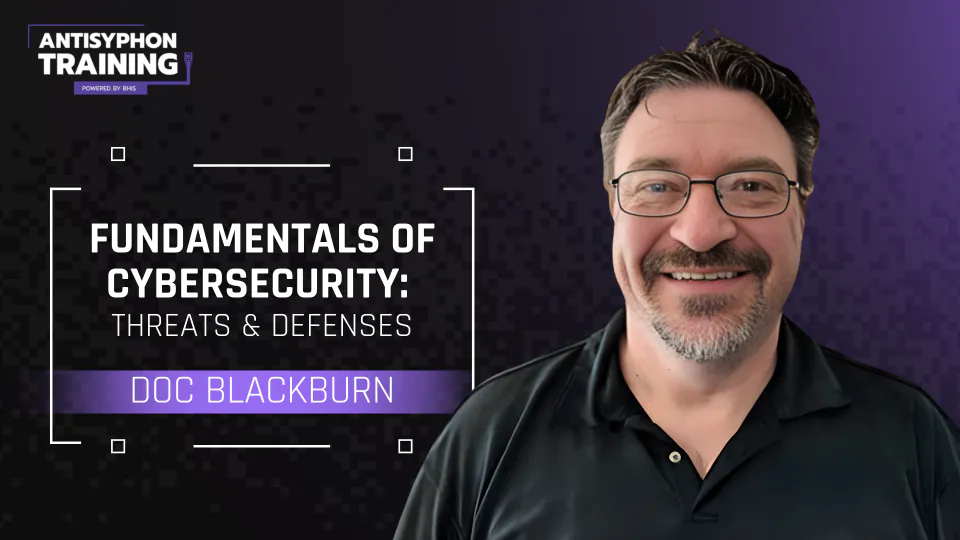
Doc Blackburn is a seasoned (old) cybersecurity instructor with decades of experience in IT, security, and compliance. Over his career, he has worked in many areas of IT, including systems administration, programming, network design, cloud services, web development, and risk management, bringing a broad technical foundation to his teaching. For more than 13 years, Doc has trained students and professionals to understand, implement, and maintain effective security practices, drawing on real-world consulting experience in compliance frameworks such as NIST SP 800-171, CIS Critical Controls, and MITRE ATT&CK. Known for making complex concepts accessible to all audiences, he blends technical depth with practical insights, preparing learners to address today’s evolving cyber threats.
This class is being taught at Wild West Hackin’ Fest – Deadwood 2026.